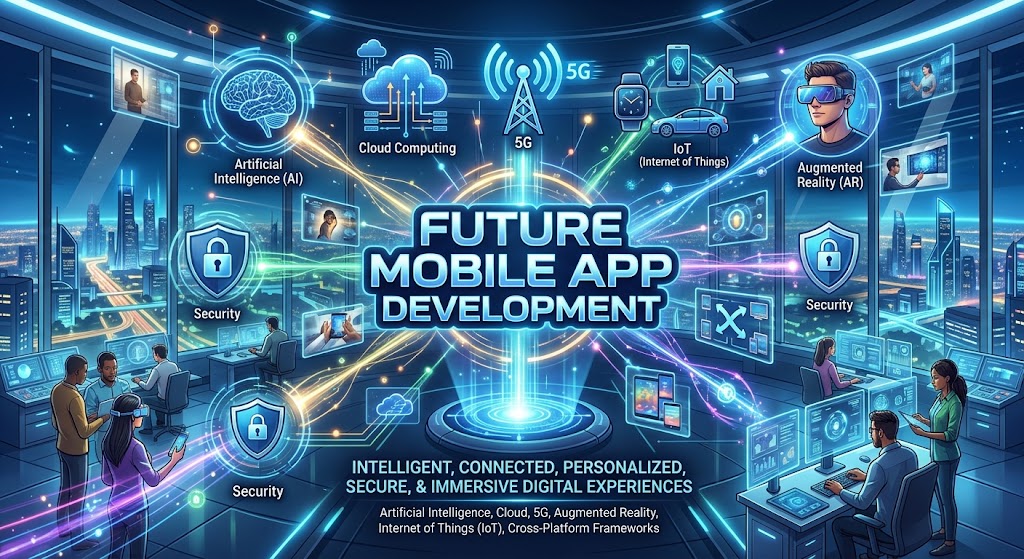
Mobile app development is evolving rapidly with advancements in artificial intelligence, cross-platform frameworks, 5G connectivity, cloud computing, and immersive technologies. This article explores the key trends shaping the future of mobile app development, how businesses can leverage emerging technologies, and what developers need to know to build faster, smarter, and more engaging mobile experiences in the years ahead.
The Future of Mobile App Development
Mobile applications have transformed the way people communicate, work, shop, learn, entertain themselves, and access services. From banking and education to healthcare and business, mobile apps have become an essential part of everyday digital life.
But mobile app development is changing rapidly. Artificial intelligence, cloud computing, 5G, augmented reality, Internet of Things (IoT), and modern cross-platform frameworks are opening new possibilities for developers and businesses.
The future of mobile app development will not simply be about creating apps that run on smartphones. It will be about building intelligent, connected, personalized, secure, and immersive digital experiences.
1. Artificial Intelligence Will Transform Mobile Apps
Artificial intelligence is likely to become one of the most influential technologies in mobile application development.
Instead of simply responding to user commands, future applications will increasingly understand user behavior, preferences, and context.
AI can be used for:
-
Personalized recommendations
-
AI-powered chatbots and virtual assistants
-
Voice recognition
-
Image and video analysis
-
Predictive analytics
-
Automated content generation
-
Fraud detection
-
Smart search
-
Personalized learning
For example, an educational application could analyze a student's performance and automatically recommend lessons and exercises based on areas where the student needs improvement.
This means developers will increasingly design applications around intelligence and personalization, rather than simply creating collections of screens and features.
2. AI-Powered Development Will Change How Apps Are Built
Artificial intelligence will not only become part of mobile applications—it will also change the development process itself.
AI-assisted development tools can help developers:
-
Generate code
-
Detect bugs
-
Explain unfamiliar code
-
Create test cases
-
Optimize code
-
Generate documentation
-
Convert designs into interfaces
-
Assist with database queries
This does not mean developers will become unnecessary. Instead, developers will spend more time solving problems, designing architecture, reviewing AI-generated code, and making important technical decisions.
The developer of the future may work alongside AI as a productivity partner.
3. Cross-Platform Development Will Continue to Grow
Businesses often want applications for both Android and iOS. Traditionally, this could require separate development teams and codebases.
Modern frameworks such as Flutter and React Native have made cross-platform development increasingly attractive.
The advantages include:
-
Faster development
-
Reduced development costs
-
Shared code
-
Easier maintenance
-
Faster feature releases
As frameworks continue to improve, the distinction between native and cross-platform development will become less important for many applications.
However, native development will continue to have an important role when applications require maximum performance, deep hardware integration, or platform-specific capabilities.
4. 5G Will Enable Richer Mobile Experiences
Faster mobile networks will enable applications to transfer and process large amounts of data more efficiently.
5G can support applications involving:
-
Cloud gaming
-
Real-time collaboration
-
High-quality video
-
Connected vehicles
-
Remote services
-
Augmented reality
-
Industrial IoT
-
Real-time analytics
As network performance improves, developers can build applications that rely more heavily on cloud infrastructure while still providing responsive experiences.
The smartphone will increasingly act as a gateway to powerful cloud-based services.
5. Cloud-Based Mobile Applications Will Become More Important
Cloud computing has already transformed web development, and its influence on mobile applications will continue to grow.
Instead of storing and processing everything on the device, applications can use cloud services for:
-
Data storage
-
Authentication
-
Machine learning
-
Image processing
-
Analytics
-
Notifications
-
Backup and synchronization
This allows mobile applications to access powerful computing resources without requiring expensive hardware on the user's device.
Cloud-native architectures can also make applications easier to scale as the number of users increases.
6. Augmented Reality Will Create New Experiences
Augmented reality (AR) combines digital information with the physical environment.
Although AR has already appeared in games and social applications, its potential extends far beyond entertainment.
Future mobile applications could use AR for:
-
Education
-
Interior design
-
Navigation
-
Shopping
-
Healthcare
-
Tourism
-
Industrial training
-
Equipment maintenance
Imagine pointing a smartphone at a machine and seeing instructions showing exactly which component needs to be repaired.
This type of experience could make mobile applications more interactive and useful in the real world.
7. Mobile Apps Will Become More Connected Through IoT
The Internet of Things connects physical devices to digital systems.
Smartphones can already interact with smart watches, televisions, vehicles, security systems, home appliances, and other connected devices.
Future applications will increasingly act as control centers for entire ecosystems of connected devices.
For example, a smart home application could allow users to monitor:
-
Lights
-
Security cameras
-
Door locks
-
Air conditioning
-
Energy consumption
-
Home appliances
Developers will therefore need to understand not only mobile interfaces but also APIs, cloud services, device communication, and real-time data processing.
8. Security and Privacy Will Become Even More Important
As mobile applications handle increasingly sensitive information, security will become a fundamental part of application development.
Applications may process:
-
Financial information
-
Personal data
-
Location information
-
Health-related information
-
Business data
-
Authentication credentials
Developers must therefore consider security throughout the entire development lifecycle.
Important practices include:
-
Secure authentication
-
Strong authorization
-
Encryption
-
Secure API communication
-
Safe data storage
-
Regular dependency updates
-
Input validation
-
Protection against common vulnerabilities
Privacy will also become increasingly important. Users want to understand what information an application collects and how that information is used.
A successful application will need to earn user trust, not simply provide useful features.
9. Voice and Natural Language Interfaces Will Grow
Touchscreens have dominated mobile interaction for years, but voice and natural language interfaces are becoming increasingly capable.
Users may increasingly interact with applications by simply describing what they want.
For example:
"Find my recent school expenses and prepare a summary."
Instead of navigating through several screens, an intelligent application could understand the request and complete the task.
This will encourage developers to think beyond traditional buttons, menus, and forms.
10. Progressive Web Apps Will Remain Relevant
Progressive Web Apps (PWAs) combine some characteristics of websites and mobile applications.
They can provide features such as:
-
Offline support
-
Installability
-
Push notifications
-
Responsive interfaces
-
Fast loading
-
Cross-platform access
PWAs can be particularly useful for organizations that want to reach users across multiple platforms without developing completely separate applications.
They will not replace native applications in every situation, but they provide another important option for delivering mobile experiences.
11. Wearables and New Devices Will Expand the Mobile Ecosystem
Mobile development is no longer limited to smartphones.
Smart watches, smart glasses, fitness trackers, foldable devices, automotive systems, and other connected products are expanding the digital ecosystem.
Developers will increasingly need to design experiences that work across multiple screen sizes and device types.
The future may therefore involve designing a connected experience rather than a single mobile application.
12. Mobile Apps Will Become More Personalized
Users increasingly expect applications to understand their individual needs.
Instead of showing identical content to everyone, applications can use data and AI to personalize experiences.
For example:
-
Shopping apps can recommend relevant products.
-
Learning apps can recommend appropriate lessons.
-
Fitness apps can adapt exercise plans.
-
Entertainment apps can recommend content.
-
Banking apps can provide personalized financial insights.
Personalization can improve engagement, but it must be implemented responsibly. Developers should balance personalization with privacy and transparency.
13. Edge Computing Can Improve Real-Time Applications
Although cloud computing is powerful, sending every piece of data to a distant server can introduce latency.
Edge computing moves some processing closer to the user or device.
This can be valuable for applications requiring fast responses, such as:
-
Autonomous systems
-
Industrial monitoring
-
Smart cities
-
AR applications
-
Real-time analytics
-
Connected vehicles
As mobile networks, devices, and cloud infrastructure evolve, edge computing may become an important part of mobile application architecture.
14. The Role of Developers Will Change
The future of mobile development will require more than knowledge of programming languages.
Developers will increasingly need to understand:
-
AI
-
APIs
-
Cloud computing
-
Cybersecurity
-
Databases
-
User experience
-
Data privacy
-
Automation
-
Software architecture
AI will automate some repetitive development tasks, but human developers will remain responsible for understanding users, designing solutions, evaluating technical trade-offs, and ensuring that applications are reliable and secure.
The most valuable developers will therefore be those who combine technical skills with problem-solving and product thinking.
15. What Businesses Should Prepare For
Businesses planning future mobile applications should think beyond simply asking, "Should we build an Android or iOS app?"
Instead, they should consider:
-
What problem does the application solve?
-
How can AI improve the user experience?
-
What data will the application collect?
-
How will the application scale?
-
Which devices should it support?
-
How will user privacy be protected?
-
Which features should run locally and which should use the cloud?
-
How will the application be monitored and maintained?
Technology should support the business objective rather than becoming the objective itself.
Conclusion
The future of mobile app development is moving toward intelligent, connected, personalized, and highly interactive experiences.
Artificial intelligence will make applications smarter. Cloud computing will provide scalable infrastructure. 5G and edge computing will enable faster real-time experiences. AR and IoT will connect digital applications with the physical world. At the same time, security and privacy will become increasingly important.
For developers, this future presents both challenges and opportunities. Learning a single programming language or framework will no longer be enough. Developers will need to understand the broader technology ecosystem and continuously adapt to new tools and approaches.
The most successful mobile applications of the future will not necessarily be the ones with the most features. They will be the ones that use technology intelligently to solve real problems, provide excellent user experiences, protect user data, and continuously adapt to changing needs.
The future of mobile app development is not simply about building better apps—it is about building smarter digital experiences.